
How Industry Leaders Are Helping Community Colleges Keep Pace with AI Workforce Change
Artificial intelligence is evolving at an unprecedented pace, creating both opportunities and challenges for community colleges preparing students for AI-enabled careers. As employers rapidly adopt new technologies and applications, academic leaders face increasing pressure to ensure their programs stay aligned with current and future workforce needs.
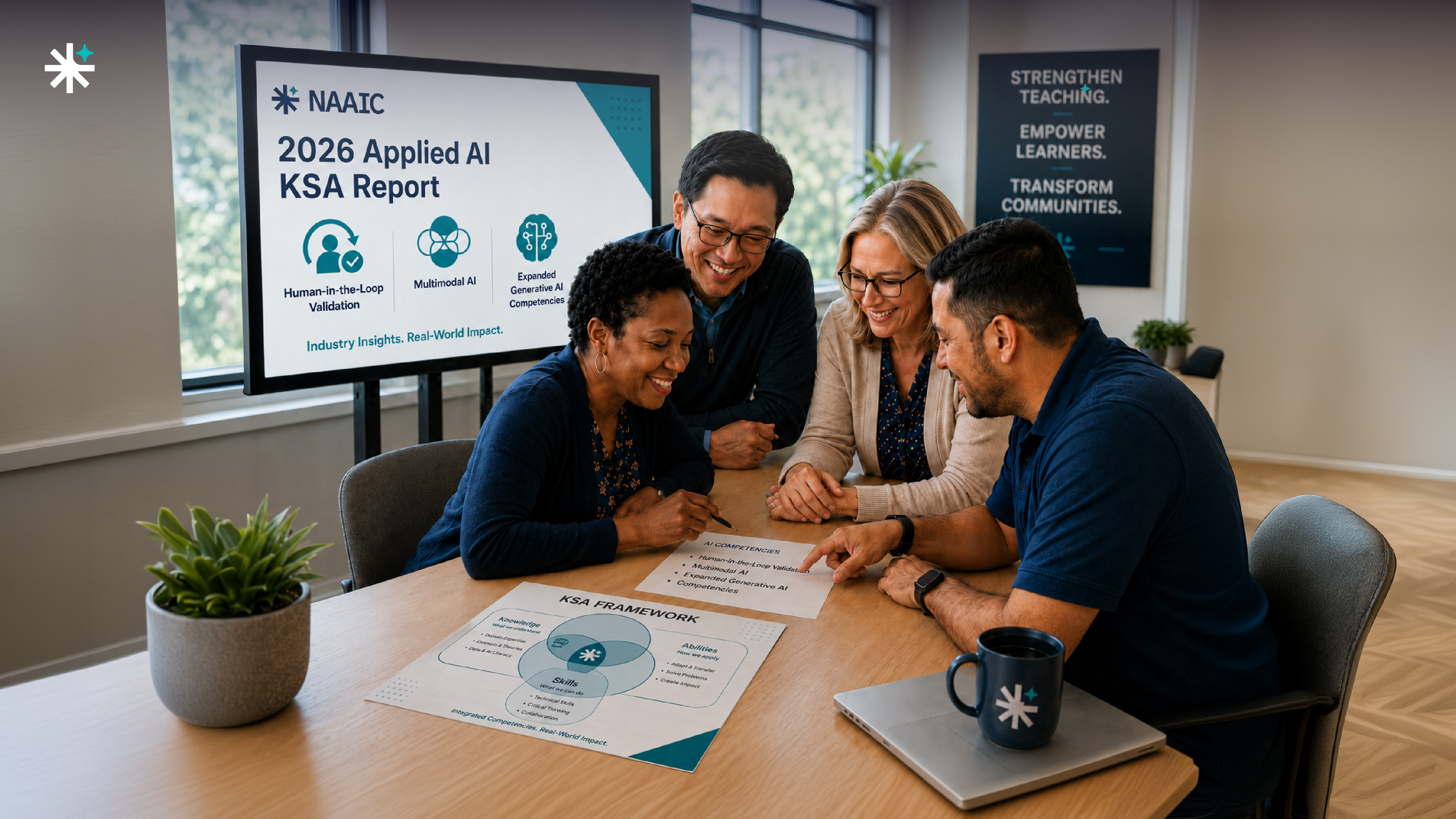
NAAIC’s 2026 Applied AI Knowledge, Skills & Abilities (KSA) Report was developed to help bridge that gap. Informed by its national Business & Industry Leadership Team (BILT), the report provides community colleges with workforce-informed guidance they can adapt through their own regional employer partnerships to keep Applied AI programs relevant and responsive.
Why the KSAs Matter
Traditional curriculum development cycles often struggle to keep pace with the speed of AI innovation. Many community colleges are launching or expanding Applied AI programs while simultaneously working to understand which competencies employers will expect graduates to have over the next several years.
The annual KSA Report serves as a resource for institutions navigating that challenge. Rather than relying on assumptions about industry demand, colleges can reference a framework informed by national leaders for AI and professionals actively working in AI and use it as a starting point for local workforce alignment. As Ann Beheler, NAAIC BILT Director, puts it, "Artificial intelligence is evolving at an unprecedented pace, which means workforce expectations are evolving just as quickly. The annual KSA review process helps community colleges have access to a national framework informed by today’s industry needs and forward facing trends, allowing them to work with their own regional employers to create or modify curriculum to better prepare students for AI-enabled careers.”
Key Workforce Insights from the 2026 Report
The 2026 update highlights several areas that reflect how employer expectations continue to evolve.
Human-in-the-Loop Validation
One of the most significant additions underscores the importance of validating AI-generated outputs for reasonableness, accuracy, and appropriateness. While tools continue to become more powerful, human oversight remains essential. Graduates entering AI-workplaces need to understand not only how to use AI systems but also how to critically evaluate their results before applying them in real-world settings.
Multimodal AI
The 2026 framework introduces multimodal AI as a new area of focus. Students increasingly need familiarity with AI systems capable of processing and integrating multiple forms of information, including text, images, video, audio, and sensor data. As AI technologies continue expanding beyond text-based interactions, workforce preparation must evolve alongside them.
Expanded Generative AI Competencies
Generative AI was already included in the previous framework, but the 2026 update expands its emphasis to reflect growing employer demand. Areas of focus include prompt engineering, knowledge of modern generative AI tools, AI safety considerations, and AI-enabled business processes. Together, these competencies reinforce that organizations increasingly expect graduates to understand how generative AI can be applied responsibly and effectively in practical workplace environments.
“The pace of change in AI requires educational institutions that can adapt quickly. Community colleges are uniquely positioned to respond to emerging workforce needs, and the NAAIC KSA framework helps connect those programs to what employers are seeing in the field,” Myra Roldan, Founder & Chief AI Officer at UnDesto, tells us. “The expanded emphasis on prompt engineering, generative AI applications, and AI safety reflects skills that organizations increasingly need today.”
Why Industry Subject Matter Expert Input Matters
A defining characteristic of the framework is that it is informed by direct participation from employers and titans of the AI industry. Organizations represented in the process include Intel, Microsoft, Lenovo, Cloudflare, World Wide Technology, Honeywell, Jobs for the Future, SeedAI, and additional AI-focused employers and practitioners. Their perspectives help identify the knowledge, skills, and abilities that are becoming increasingly important across AI-enabled workplaces. This industry participation provides community colleges with current workforce intelligence that can support curriculum planning and program development.
A National Framework with Local Flexibility
The KSA Report is intended to serve as a starting point rather than a one-size-fits-all solution. Community colleges are encouraged to use this framework alongside conversations with local employers to determine which competencies are most relevant within their own region and how those priorities should be reflected in curriculum and learning outcomes. For colleges with existing AI programs, that may mean comparing current competencies against the 2026 report, identifying potential gaps, and working with regional employers to prioritize updates.
For institutions developing new Applied AI programs, the report can help guide planning by identifying high-priority competencies while engaging local industry partners early in the curriculum design process. “Community colleges play a critical role in preparing the workforce that will implement, manage, and apply AI across every industry. By bringing employers directly into the curriculum conversation, we can help ensure students are learning the skills organizations need today and will need over the coming years,” Antonio Delgado, Vice President of Innovation and Technology Partnerships at Miami Dade College, notes.
Preparing for What’s Next
AI will continue to evolve, and workforce expectations will continue evolving with it. Maintaining alignment between education and industry requires ongoing collaboration and access to current workforce insights. By bringing together employers, practitioners, and educators through its Business & Industry Leadership Team, NAAIC is committed to provide community colleges with a workforce-informed KSA report once a year. For our next Applied AI KSA cycle, we plan to round up this year’s report with the Abilities required for AI practitioners. The result will be a full approach to helping students develop the knowledge, skills, and abilities needed for an AI-enabled future.
Other News
From Mentorship to Momentum: A Look at NAAIC’s 2025-2026 Institutional Mentorship Program
.jpg)
NAAIC Receives NSF Supplemental Funding to Advance National AI Dual Credit Pathways